 - v2.jpg)
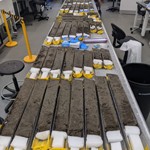 IMAGE COPYRIGHT National Oceanography Centre
 Mud on the move
Join the BOSCORF team to explore what really lies at the bottom of the deep ocean.
If you swam out to the middle of the ocean and dived straight down, you might expect to find deep layers of sand - but you'd be wrong. In most places, you'd land on kilometres‑thick piles of tiny shells and fish poo.
As marine life dies, it gently sinks to the seafloor as 'marine snow'. Under a microscope, you'd see countless plankton shells - tiny organisms from the base of the food chain that are now fossilised!
But what about the sand? Where did it go? Well, if you dug into these piles, you would find sand as thin layers sandwiched between the marine snow. There wouldn't be much as you would be far from land, but the sand that you would find travelled hundreds of miles to get to the deep sea.
Together with marine snow, these layers stack up, one on top of the other, to form patterns like tree rings, revealing our ocean's floor's dynamic history. Use the evidence on our stand and experiment with our flume tank to discover how sand and marine show journey together to the deep sea.
If you swam out to the middle of the ocean and dived straight down, you might expect to find deep layers of sand - but you'd be wrong. In most places, you'd land on kilometres‑thick piles of tiny shells and fish poo.
As marine life dies, it gently sinks to the seafloor as 'marine snow'. Under a microscope, you'd see countless plankton shells - tiny organisms from the base of the food chain that are now fossilised!
But what about the sand? Where did it go? Well, if you dug into these piles, you would find sand as thin layers sandwiched between the marine snow. There wouldn't be much as you would be far from land, but the sand that you would find travelled hundreds of miles to get to the deep sea.
Together with marine snow, these layers stack up, one on top of the other, to form patterns like tree rings, revealing our ocean's floor's dynamic history. Use the evidence on our stand and experiment with our flume tank to discover how sand and marine show journey together to the deep sea.
You may also like
100 Years of Ocean Discovery | Exhibition
100 years ago, RRS Discovery was designated the UK's first Royal Research Ship. This was a pivotal moment in the history of marine science and launched a legacy of global oceanogra ...Read More
Boldrewood Innovation Campus
Earth Beneath Oceans: a seafloor geology discovery mission
Geologists study the rocks of our planet to understand how it works, but two thirds of Earth's surface is covered by oceans, so how can we study submarine rocks and why are they im ...Read More
Boldrewood Innovation Campus
